


Eight European Cities for January Sunseekers


While Northern Europe disappears under grey skies at four in the afternoon, these eight cities are eating lunch outdoors—no long-haul flight, no jet lag, just a few hours south.
It is January in London. Or Frankfurt, Amsterdam or Dublin. The sun rises after eight, sets before half past four, and in between it mostly doesn’t bother. Meanwhile, in Las Palmas, people are swimming. In Seville, the orange trees are heavy with fruit. In Athens, locals wait for the alkyonides meres, the halcyon days, a spell of calm, bright weather that often arrives mid-winter.
Southern Europe in January is not the Caribbean. Pack a jacket for the evenings. But daytime highs between 13 and 21 degrees, low-season hotel prices on the mainland and museums without queues add up to the smartest winter break on the continent. Here are eight cities, ranked from warmest to coolest by average January daytime high, with ten things to do in each.
Las Palmas de Gran Canaria, Spain

Average January high: around 21°C. Sea: around 19–20°C.
Gran Canaria lies far closer to the coast of Africa than to mainland Spain, and you feel it the moment you step off the plane. Locals will happily tell you their city has the best climate in the world. In January, nobody argues.
With close to 382,000 people, it is the largest city in the Canary Islands, and its port has served Atlantic shipping since Columbus sailed through. The city has two halves. The old quarters of Vegueta and Triana lie to the south, while the beach, the port, and the bar-filled streets around Santa Catalina lie to the north. The city buses, called guaguas, link the two in about twenty minutes. This winter, you also get carnival: the 2027 edition runs from 22 January to 28 February, and the city takes it very seriously.
Swim at Playa de Las Canteras. Three kilometres of golden sand in the middle of the city, shared by joggers, swimmers and older men playing dominoes. A natural reef called La Barra lies a short swim offshore and breaks the Atlantic swell, so the water inside stays calm and clear. Bring a snorkel. Walk the promenade at sunset, and you will see why so many remote workers never went home.
Walk Vegueta. The city was founded here in 1478. The streets are cobbled, the mansions have dark wooden balconies, and many of the churches are older than most cities in the Americas. Go on a weekday morning when the only sound is your own footsteps.
Visit Casa de Colón. Columbus stopped on Gran Canaria in 1492, on his way to what he believed was Asia. The museum in the old governor’s residence covers the island’s role in the Atlantic crossings, with maps, navigation instruments, and a section on America before Europeans arrived. The carved wooden ceilings and courtyards are half the reason to come.
Climb the Catedral de Santa Ana. The building started in 1497 and dragged on for four centuries, so you get Gothic and neoclassical in the same church. Take the lift up the tower for views over the rooftops of Vegueta, the harbour, and the mountains. On the square below stand bronze dogs. The islands are named after dogs, from the Latin canis, not after the yellow bird.
Surf at La Cícer. At the southern end of Las Canteras, the reef stops protecting the beach, and the waves arrive, especially when winter swells roll in from the Atlantic. Surf schools line the promenade and rent out boards to beginners and regulars alike. If you prefer to watch, the beach bars here have front-row seats.
See the Museo Canario. Before the Spanish conquest, Gran Canaria belonged to a people known as the Canarii. This museum is dedicated to them. The walls lined with skulls and mummies grab attention, but the small clay figures, pottery, and tools say more about how people actually lived. Spend an hour here and the island makes more sense.
Eat at Mercado de Vegueta. Opened in the 1850s, it is the oldest market in the Canary Islands, and it still serves the neighbourhood rather than tourists. Order a coffee at a counter and look around: tropical fruit, local cheese, Atlantic fish on ice. Then find papas arrugadas, small potatoes boiled in heavily salted water until the skins wrinkle, served with red and green mojo.
Drive into the mountains. An hour inland, Gran Canaria turns into pine forest and deep ravines, with the volcanic pillar of Roque Nublo standing above the clouds. The village of Tejeda clings to a ridge and is the usual lunch stop. Buy the almond sweets. From late January, the almond trees around the village often start to bloom.
Wander the Jardín Botánico Canario. A short drive from the centre, this botanical garden is devoted to the plants of the Canary Islands, many of which grow nowhere else. Look for the dragon trees, ancient and slightly prehistoric in shape. The paths run down a steep ravine, so leave the sandals at the hotel.
Catch a concert at Auditorio Alfredo Kraus. The concert hall at the end of Las Canteras is named after the tenor born in Las Palmas, and the stage has a giant window onto the Atlantic behind the musicians. From 9 January to 4 February 2027, the Canary Islands International Music Festival brings orchestras including the Royal Concertgebouw of Amsterdam, the Vienna Symphony and the London Philharmonic to the islands.
Funchal, Madeira, Portugal

Average January high: around 19°C.
Madeira calls itself the island of eternal spring, and Funchal is where the slogan comes from. The city sits in a bowl on the south coast, with mountains behind it that block the northern winds. The temperature hardly moves from one month to the next. The first Portuguese settlers arrived in the 1420s and named the place after funcho, the wild fennel growing on the slopes.
About 105,000 people live in Funchal. You get gardens, a busy old town, great fish, one of the world’s great fortified wines, and an island full of mountain trails within an hour’s drive. Winter is high season. Half of Northern Europe seems to think the same, so book early.
Take the cable car up. It starts in the Old Town, the Zona Velha, and climbs for about a quarter of an hour over rooftops, banana plots and gardens to the hilltop parish of Monte. At the top, step into the church of Nossa Senhora do Monte. Charles I, the last Habsburg emperor of Austria, died in exile on Madeira in 1922 and is buried here.
Ride the Monte toboggan down. Since the 1800s, wicker sledges have carried passengers down the steep streets from Monte. Two men in white with straw hats, the carreiros, run alongside, steering and braking with their rubber-soled boots. The ride covers around two kilometres in about ten minutes. Yes, it is a tourist trap. Do it anyway.
Get lost in Monte Palace Tropical Garden. Right next to the cable car station, this hillside garden mixes exotic plants, koi ponds, oriental pagodas and long panels of old Portuguese tiles. Two hours disappear easily. Arrive early, before the coaches.
Shop at Mercado dos Lavradores. The farmers’ market has occupied this Art Deco building, decorated with painted tiles, since 1940. Upstairs, the fruit sellers stack several types of passion fruit and the creamy anona. Downstairs is the black scabbardfish, espada, a deep-sea fish with teeth that belong in a horror film. On the plate, it is mild and delicious, often served with fried banana. The fruit sellers hand out free samples, then charge tourist prices, so ask the price per kilo first.
Walk Rua de Santa Maria. Funchal’s oldest street used to be a run-down fishermen’s quarter. Then came a project called arte de portas abertas, art of open doors, which invited artists to paint the front doors of the old houses. The street now has hundreds of painted doors and is lined with restaurants. See the doors by day and come back for dinner.
Hike a levada. More than 2,000 kilometres of levadas, narrow channels built to carry water from the wet north of the island to the farms in the south, run across Madeira. The flat maintenance paths beside them make for easy walking through spectacular landscape. Levada dos Balcões starts at Ribeiro Frio, about 40 minutes by car from Funchal. It takes just over half an hour each way and ends at a viewpoint over the central mountains. The chaffinches there will eat from your hand if you let them.
Taste Madeira wine at Blandy’s Wine Lodge. The Blandy family has been making wine in Funchal since 1811, and their lodge sits in a former Franciscan monastery in the centre. On the tour, you see the warm lofts where the wine ages. That heat is what gives Madeira its burnt caramel flavour and lets a bottle last a century. Finish with a dry Sercial and a sweet Malmsey side by side.
Drive up to Pico do Arieiro. You can drive almost to the top of the island’s third-highest peak, at 1,818 metres. Get there for sunrise, which comes after eight in January, and watch the sun break over a sea of clouds. It can be close to freezing at the top. The famous trail on to Pico Ruivo, the highest summit, reopened in April 2026 after the wildfires, but now runs one way only and must be booked in advance.
Drink poncha. A sugarcane spirit, honey, and lemon juice, stirred with a wooden stick called a caralhinho. Poncha comes in small glasses and disappears fast. It was born in the fishing village of Câmara de Lobos, 15 minutes west of Funchal, and the bars around the harbour there pour the real thing.
Visit the CR7 Museum. Cristiano Ronaldo grew up in Funchal, and the island has embraced him completely: the airport carries his name, and a bronze statue of him stands outside his museum by the marina. Inside are his trophies and awards. Even people who don’t follow football end up taking a picture with the statue.
Málaga, Spain

Average January high: around 17°C.
For decades, Málaga was the airport you used to get to Marbella or Torremolinos. That changed when the city rebuilt the port and made the old town pedestrian-only. Tech companies followed. Málaga today is one of the liveliest cities in Spain.
It is also very old. The Phoenicians founded it as Malaka nearly three thousand years ago, and Romans and Moors followed before the Catholic monarchs took the city in 1487. You can see all of these periods within a ten-minute walk of the cathedral. The airport train takes around 12 minutes to the centre, which makes Málaga one of the easiest city breaks in Europe.
See the Museo Picasso Málaga. Picasso was born here in 1881. The museum opened in 2003 in the 16th-century Palacio de Buenavista and holds more than 200 works donated by his family, from early academic portraits to his late, wild experiments. His birthplace, Casa Natal, is a few minutes away on Plaza de la Merced. A bronze Picasso sits on a bench outside, waiting for selfies.
Climb the Alcazaba. The Moors built this fortress palace mainly in the 11th century, and outside the Alhambra, nothing is better preserved of its kind in Spain. You climb through gates, courtyards, fountains and gardens, ring after ring of walls. It has a fraction of the Alhambra’s crowds.
Keep climbing to Gibralfaro. The castle on top of the hill was built in the 14th century to guard the palace below. From its ramparts, you can see the whole city: the bullring, the port, the cathedral, and the Mediterranean. The path up is steep. Take a taxi up, walk down and save your knees. One combined ticket covers both the Alcazaba and Gibralfaro.
Spot the Roman Theatre. Built in the 1st century BC under Emperor Augustus, the theatre lay buried for centuries until workers found it in 1951. The restored stone seats now sit right below the Alcazaba, and entry is free. A small visitor centre shows how they dug it out.
Visit Centre Pompidou Málaga. In 2015, the Paris museum opened its first branch outside France here, inside a cube of coloured glass on the port designed by the artist Daniel Buren. The collection changes every few years and covers modern and contemporary art. The agreement with Paris runs until 2034. Closed on Tuesdays.
Tour the cathedral rooftop. Work started in 1528 and was never finished. The south tower stops halfway, which is why locals call the cathedral La Manquita, the one-armed lady. The popular story says the money went to support the American War of Independence. The rooftop tour takes you across the vaults, with the city spread out below.
Explore Soho. The old warehouse district between the old town and the port became an arts quarter through a street art project that started in 2013. International artists have painted entire building walls, including Shepard Fairey, the man behind the Obama “Hope” poster. The contemporary art centre CAC Málaga, also in Soho, is free to enter.
Eat espetos. An espeto is a row of sardines on a skewer, grilled over a wood fire, often in an old fishing boat filled with sand on the beach. Head to the old fishing district of Pedregalejo, where the beach restaurants sit side by side. Locals say sardines are better in summer. Order them anyway, and add boquerones, fried fresh anchovies. People from Málaga are called boquerones.
Drink at Antigua Casa de Guardia. Málaga’s oldest bar has been pouring sweet local wine from the barrel since 1840. There are no chairs. The bartender chalks what you owe on the wooden counter in front of you and adds it up when you leave. Order a Pedro Ximénez or a Moscatel and a plate of mussels.
Day trip to Caminito del Rey. A walkway pinned to the walls of a deep gorge, built in the early 1900s for workers at a hydroelectric plant. For years it was known as the most dangerous path in the world. After a full rebuild, it reopened in 2015, and now it is safe and still dizzying. It is about an hour from Málaga by car or train. Book early, as visitor numbers are capped, and it closes in bad weather.
Valencia, Spain

Average January high: around 16°C.
Valencia is Spain’s third-largest city, with around 800,000 people, and most visitors still skip it for Barcelona or Madrid—their loss. The Romans founded the city in 138 BC, and today it combines a compact historic centre, some of Europe’s most futuristic architecture, a long city beach and the dish the whole world knows: paella.
It is also one of Europe's easiest cities to live in. Valencia was European Green Capital in 2024, and it is flat, sunny and made for cycling. In January, the city has its quiet weeks before the Fallas festival explodes in March. You will share the museums and markets with locals.
Cycle the Turia Gardens. In 1957, the Turia River flooded Valencia so badly that the city moved it. The river was diverted around town, and the empty riverbed became a nine-kilometre park of football pitches, orange trees, running paths and playgrounds, crossed by old stone bridges. Rent a bike and ride the whole length. Stop at the Gulliver playground, where children climb all over a giant, fallen Gulliver.
See the City of Arts and Sciences. At the end of the Turia stands Santiago Calatrava’s white complex, with buildings shaped like an eye, a skeleton and a helmet. Inside are a science museum, an opera house, an IMAX cinema and the Oceanogràfic, the largest aquarium in Europe. Even if you skip them all, walk around the turquoise pools in the late-afternoon light.
Shop at the Mercado Central. Under a modernist dome of iron, glass and tiles, the market has fed the city since 1928. A parrot-shaped weathervane sits atop the dome. Inside, there is everything from cured ham to sacks of local short-grain rice. Come before noon on a weekday, when the stallholders are at their loudest.
Eat real paella. Paella comes from the rice fields around Valencia, and the original has little to do with what you get on tourist menus in Barcelona. Valencians use chicken, rabbit, green beans and large white garrofó beans, with saffron, in a wide, shallow pan, ideally over an open fire. The crust burnt onto the bottom, the socarrat, is what everyone fights over. Paella is for lunch. Order it for dinner, and the waiter will know you are not from here.
Take a boat on the Albufera. South of the city is the Albufera, a large freshwater lagoon surrounded by rice fields. In the village of El Palmar, fishermen take visitors out in flat-bottomed boats. Go at sunset. In winter, the rice fields are flooded, and thousands of migrating birds stop here.
See the Holy Grail. Valencia’s cathedral says it has the cup Jesus drank from at the Last Supper. The agate cup, in a chapel of its own, has been dated by some archaeologists to around the time of Christ, and two popes have used it during masses in the city. Climb the 207 steps of the Miguelete tower for the best view in town. On Thursdays at noon, the Water Tribunal meets at the cathedral’s Apostles’ Door, as it has for centuries, to settle disputes between farmers over irrigation.
Visit La Lonja de la Seda. The silk exchange was built at the end of the 15th century, when Valencia was one of the richest trading cities in the Mediterranean. It is now on the UNESCO World Heritage List. The main hall’s spiral columns rise like palm trunks and open out into the vaulted ceiling. Stand in the middle and look up.
Drink horchata with fartons. Horchata is a sweet, cold, milky drink made from tiger nuts, a small tuber grown around Alboraya, just north of the city. It comes with fartons, long glazed buns made for dunking. Several horchaterías in the old town have been in business for well over a century. Order a glass, dunk, repeat.
Bar-hop in Ruzafa. Ruzafa used to be a working-class district. Now it has independent shops, galleries, cafés and cocktail bars, and rents to match. Start at the colourful Ruzafa market. After dark, the narrow streets fill with Valencians out for tapas.
Walk Malvarrosa beach. Take the tram or a bike from the centre to Valencia’s long city beach. The water is too cold for most people in January, but the wide promenade is made for a slow walk. Then sit down for rice at La Pepica on the seafront, which has served paella since the 19th century and once fed Ernest Hemingway.
Seville, Spain
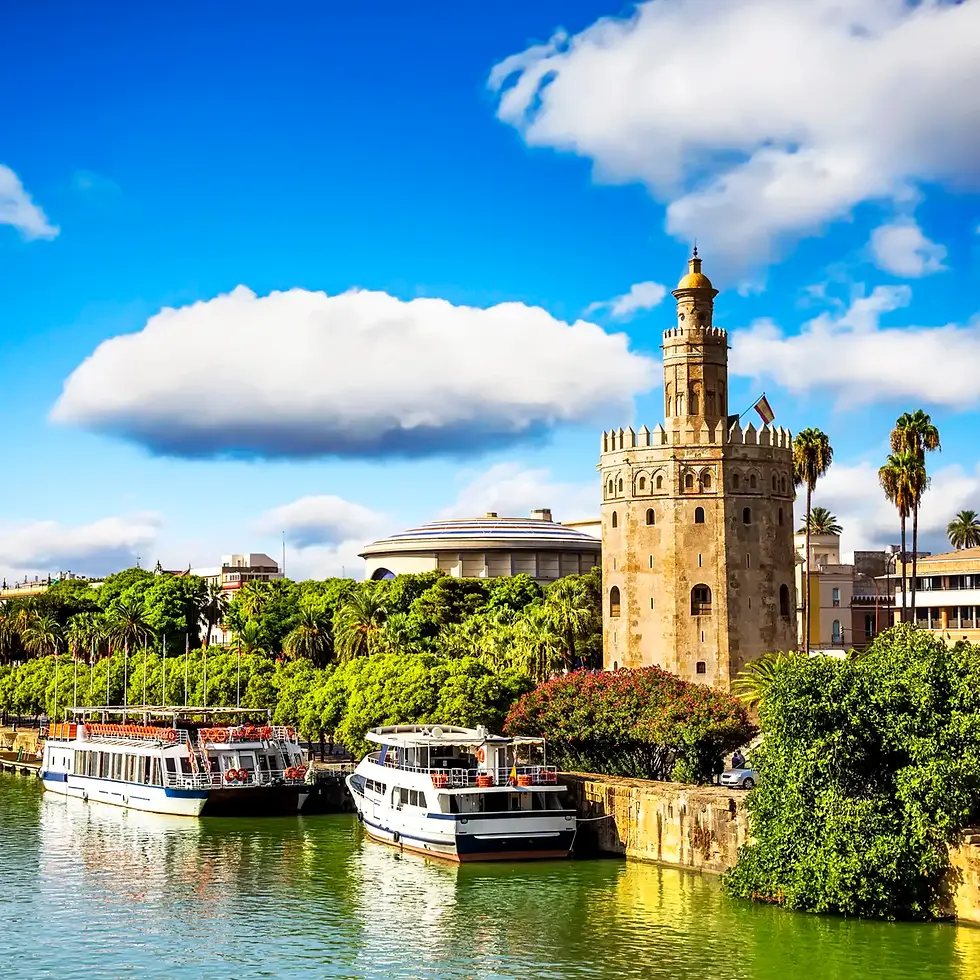
Average January high: around 16°C.
Seville is the Spain of postcards: flamenco, orange trees, horse-drawn carriages and tapas bars spilling onto the pavement. The capital of Andalusia has about 690,000 inhabitants. In the 16th century, it held the royal monopoly on trade with the Americas, and silver pouring in from the New World paid for the palaces and churches you see today.
Three UNESCO World Heritage Sites stand within a few hundred metres of each other: the cathedral, the Alcázar and the Archive of the Indies. In summer, the thermometer regularly passes 40 degrees, and the city is almost unbearable. January is the opposite. Mornings are cool, but by lunchtime you will be eating outside in the sun. It is also orange season.
Book the Real Alcázar. It began as a Moorish fortress. In the 14th century, King Pedro I rebuilt it in the Mudéjar style, where Islamic craftsmanship meets Christian royal taste. The Spanish royal family still uses the upper floors, making it Europe's oldest royal palace still in use. Game of Thrones used the gardens as Dorne. Book a timed ticket online and allow at least two hours.
Climb the Giralda. The cathedral’s bell tower started life as the minaret of the great mosque of the Almohads, built in the 12th century. There are no stairs, just 35 ramps, wide enough for the muezzin to ride a horse to the top. The view from almost 100 metres covers the whole old town. The cathedral below, built on the mosque site, is the world's largest Gothic cathedral.
See Columbus’s tomb. Four giant bronze heralds carry Columbus’s coffin through the cathedral. They represent the old kingdoms of Castile, León, Aragon and Navarre. His remains came here from Havana in 1898, when Spain lost Cuba. DNA tests have since backed the claim that at least some of the bones are his.
Walk Plaza de España. Seville built this huge half-moon of brick and tiles for the Ibero-American Exposition of 1929. Along the wall, a tiled alcove for each Spanish province shows its map and a scene from its history. Rent a rowing boat on the canal. Star Wars fans will recognise it from Attack of the Clones.
Go up the Setas. The Metropol Parasol, billed as the world's largest wooden structure, was designed by German architect Jürgen Mayer and opened in 2011. Sevillanos call it Las Setas, the mushrooms. A walkway winds across the top, and at sunset the whole old town turns gold. In the basement, Roman ruins found during construction are on display.
Watch flamenco in Triana. Across the Guadalquivir lies Triana, the old home of Seville’s Roma community and of many great flamenco artists. The neighbourhood also has a long ceramics tradition, and some workshops still paint tiles by hand. Skip the big dinner shows. Look for a small venue in Triana or the old town, or visit the Flamenco Dance Museum.
Eat at Mercado de Triana. The market at the end of the Isabel II bridge sits on the ruins of the Castillo de San Jorge, headquarters of the Spanish Inquisition from 1481. A free museum underneath tells that history plainly. Upstairs, the tapas bars between the stalls are among the best places to eat in Seville.
Look up at the oranges. Tens of thousands of bitter orange trees line Seville’s streets, and in January they are full of fruit. Don’t pick them. The oranges are far too sour to eat raw. Much of the harvest goes to Britain, where Seville oranges are the classic marmalade fruit.
Soak in a Moorish-style bathhouse. Several hammams in the old town recreate the bathing culture of Al-Andalus, moving from warm to hot to cold pools under candlelit brick vaults. Most also offer massages. After a day on cold stone floors, this is where you want to end up.
Catch the Three Kings parade. The Ateneo de Sevilla, a cultural society, has organised the Cabalgata de Reyes Magos every year since 1918. On 5 January, the floats leave the old tobacco factory, now the university, at 4 pm and wind through the city for hours. The Kings and their helpers throw tonnes of sweets into the crowd. Sevillian children hold umbrellas upside down to catch more.
Valletta, Malta

Average January high: around 15°C.
After the Knights of St John beat the Ottoman army in the Great Siege of 1565, they built a new capital on the narrow peninsula between two harbours. They named it after their leader, Grand Master Jean de la Valette, and laid it out on a strict grid. Almost all of it is still standing, and the whole city is a UNESCO World Heritage Site.
Valletta is one of Europe's smallest capitals. You can walk from end to end in twenty minutes. English is an official language, the currency is the euro, and traffic drives on the left, a leftover from British rule. In January, the cruise ships are few, and you have the baroque churches and bastions largely to yourself.
See the Caravaggio. St John’s Co-Cathedral looks plain and military from the street. Inside, it explodes in gold, painted ceilings and a floor made of hundreds of marble tombstones of knights. In the oratory hangs The Beheading of Saint John the Baptist, which Caravaggio painted in 1608 while he was a member of the order. It is his largest painting, and the only one he ever signed.
Watch the noon gun. The Upper Barrakka Gardens, on top of the city walls, look straight across the Grand Harbour to the Three Cities. On the terrace below, the Saluting Battery fires a cannon at noon and again at 4 pm, Monday to Saturday. You can watch for free from the gardens or pay to stand on the gun deck. Afterwards, the Barrakka lift takes you down to the waterfront in seconds.
Visit Fort St Elmo. During the Great Siege, the defenders of this star-shaped fort at the tip of the peninsula held out against the Ottoman army for weeks. It now houses the National War Museum. The most moving object is the George Cross, awarded by King George VI to the whole island in 1942 for holding out under German and Italian bombing.
Cross to the Three Cities. Before Valletta existed, the Knights lived in Birgu, Senglea and Cospicua, on the far side of the Grand Harbour. A dgħajsa, a painted wooden water taxi, takes you across for a few euros. Birgu, also called Vittoriosa, is worth exploring, with its narrow, quiet streets and Fort St Angelo on the point.
See the Grandmaster’s Palace. The Grand Masters of the Order of St John ruled from here, then the British governors. Today it holds the office of the President of Malta. The state rooms are hung with tapestries and frescoes of the Great Siege, and the armoury holds one of Europe's largest collections of arms and armour.
Eat pastizzi. Flaky, diamond-shaped pastries filled with ricotta or mushy peas, sold for around a euro from hatches in the wall all over the island. The Maltese eat them at any hour. Eat yours hot, with a Kinnie, the bittersweet local orange soda.
Drink on Strait Street. Generations of British sailors knew this narrow street as The Gut. It was full of bars, music halls and brothels. It then lay dead for decades, until wine bars and small restaurants moved in. Today it is the best street in the capital for an evening drink.
Day-trip to Mdina. Malta’s old capital stands on a hill in the middle of the island, behind thick walls. The streets are so quiet it is called the Silent City, and its main gate appeared in the first season of Game of Thrones. Order the chocolate cake at Fontanella Tea Garden on the ramparts, where you can see almost the whole island. Rabat, right next door, has early Christian catacombs.
Book the Hypogeum. In 1902, builders digging a cistern broke into an underground burial complex carved out of the rock around 5,000 years ago. Ħal Saflieni Hypogeum is a UNESCO World Heritage Site, and its so-called Oracle Room carries a man’s voice through the chambers in a way that still raises the hair on your neck. Only a few visitors are let in each day. Book weeks, preferably months, in advance.
Take the fast ferry to Gozo. The fast ferry from Valletta reaches Malta’s sister island in about 45 minutes. Gozo is greener, slower and more rural. In the capital, Victoria, walk the Citadel walls. The Ġgantija temples, among the oldest freestanding buildings in the world, predate both Stonehenge and the pyramids of Egypt.
Palermo, Sicily, Italy

Average January high: around 15°C.
Phoenicians, Romans, Byzantines, Arabs, Normans, Spaniards: all ruled Palermo at some point, and all left something behind in the buildings and on the plate. The clearest example is the city’s 12th-century Arab-Norman churches and palaces, listed together as a UNESCO World Heritage Site.
For years, Palermo was known for decay and the Mafia. The airport is named after Giovanni Falcone and Paolo Borsellino, the anti-Mafia judges murdered in 1992, and since then shopkeepers and citizens have openly fought back against extortion. The city is still chaotic, crumbling and thoroughly alive. The street food is among the best anywhere, and in January you barely see any other tourists.
See the Cappella Palatina. Inside the Norman Palace, now the seat of the Sicilian regional parliament, is the private chapel of King Roger II, consecrated in 1140. Byzantine artists covered the walls in gold mosaics, while Muslim artisans carved the wooden ceiling. A Christian king, Greek mosaics, an Islamic ceiling: that is Palermo in one room.
Go up to Monreale. The hill town of Monreale lies about eight kilometres above the city. Its cathedral, begun in 1174 by the Norman king William II, has more than 6,000 square metres of mosaics telling the stories of the Bible. Leave time for the cloister next door, where more than 200 pairs of columns are each carved differently.
Eat your way through Ballarò. Palermo’s oldest market goes back to Arab times and still feels like a souk. Vendors sing out their prices in a chant called the abbanniata. Between the fish, vegetables and spices, small stands fry snacks and grill meat on the spot. Skip breakfast.
Do the street food circuit. Start with an arancina, a fried rice ball filled with ragù or ham and cheese. In Palermo it is feminine. In Catania, on the other side of the island, it is arancino, and the two cities still argue about it. Then try panelle, chickpea fritters in a bun, and sfincione, a thick, spongy pizza with onion, anchovy and cheese. If you are brave, order pani ca’ meusa, a sandwich of veal spleen and lung fried in lard. Antica Focacceria San Francesco has served it since 1834.
Stand at Quattro Canti. The baroque crossroads built in the early 1600s divides the old town into four quarters. Each of its four curved facades carries fountains and statues of a season, a Spanish king and one of the city’s patron saints. Around the corner, the Fontana Pretoria is nicknamed the Fountain of Shame because of all the naked statues.
Tour Teatro Massimo. Italy’s largest opera house opened in 1897. Guided tours take you into the auditorium and the royal box. The final scene of The Godfather Part III was filmed on the steps outside. The opera season runs through the winter, so check what is on.
Descend into the Capuchin Catacombs. In the late 16th century, the Capuchin friars started preserving their dead in the tunnels under the monastery. The city’s wealthy soon wanted the same. Around 8,000 mummified bodies now line the corridors, many in their best clothes. The best-known is Rosalia Lombardo, a two-year-old girl who died in 1920 and looks as if she has just fallen asleep. You will not forget it.
Walk Mondello. Palermo’s beach suburb lies in a bay between two mountains, with pale sand and clear water. It is too cold to swim in January, but the promenade is lovely, and the Art Nouveau bathing pavilion built out over the water in the early 1900s is the local landmark. Have a long seafood lunch on the seafront before the bus back.
Eat cannoli. A crisp pastry tube filled with sweetened sheep’s milk ricotta. A good cannolo is filled while you wait, never before, or the shell goes soft. Many Palermitans say the best come from Piana degli Albanesi, a town in the hills above the city. Also try frutta martorana, marzipan shaped and painted like fruit, named after the convent whose nuns invented it.
Train to Cefalù. The train along the coast takes about an hour. Cefalù’s Norman cathedral, begun by Roger II in 1131, has an enormous mosaic of Christ in the apse that stares straight at you. Climb La Rocca, the rock above town, for a view over the rooftops and the sea. Film fans will recognise the town from Cinema Paradiso.
Athens, Greece

Average January high: around 13–14°C.
People have lived in Athens for more than 3,000 years, and the past keeps getting in the way. Ancient walls appear in the basements of apartment blocks, and when workers built the metro, they found so many artefacts that several stations now display them. Above it all is the Acropolis, visible from almost every corner of the city.
Modern Athens is big, loud and energetic, with close to four million people in the wider urban area, and a food, street art and nightlife scene to match. It is the coolest city on this list in January, but often surprisingly sunny. In summer, the Acropolis is a sweaty crush of tour groups. In January, it is just you, the marble and a clear sky.
Climb the Acropolis early. The Parthenon was built in the 5th century BC as a temple to Athena, and it is still the symbol of ancient Greece. Restoration has been under way since the 1970s, so expect scaffolding and a crane or two. In winter, the site opens at 8 am and closes at 5 pm. The first hour is the quietest of the entire year. Wear shoes with grip, as the old marble is slippery, especially after rain.
Visit the Acropolis Museum. Bernard Tschumi’s museum at the foot of the hill opened in 2009. Glass floors show the ruins of an ancient Athenian neighbourhood excavated under the building. The top floor is turned to face the Parthenon and displays its frieze. White plaster copies fill the gaps where the originals sit in the British Museum in London. The point is made without a word.
Walk the Ancient Agora. This was the marketplace and political centre of ancient Athens, where Socrates questioned anyone who would listen. The Temple of Hephaestus, from the 5th century BC, is one of the best-preserved ancient Greek temples anywhere, mainly because it served as a church for centuries. The rebuilt Stoa of Attalos houses a small museum.
Get lost in Anafiotika. Under the north side of the Acropolis is a tiny cluster of whitewashed houses and alleys that looks like it was lifted from a Cycladic island. Workers from the island of Anafi built it in the 19th century, when they came to Athens to build King Otto's palace. Local lore says they put the houses up overnight, using a law that protected any home with a roof by sunrise.
See the Antikythera mechanism. The National Archaeological Museum holds the world’s largest collection of ancient Greek art. Its star is a lump of corroded bronze found in a shipwreck in 1901: the Antikythera mechanism, around 2,000 years old and often called the first computer. It could calculate planetary positions and predict eclipses. Then go and find the golden Mask of Agamemnon from Mycenae.
Shop at Varvakios. The central market on Athinas Street is meat, fish and noise. In the covered halls, butchers and fishmongers try to outshout each other. The streets around it sell spices, olives, cheese and nuts. The small tavernas nearby feed market workers by day and night owls in the small hours.
Watch the sunset from Lycabettus. At 277 metres, Lycabettus is the highest hill in central Athens. From the top, you see the whole city, the Acropolis and the sea. Walk up through the pines from the smart Kolonaki district or take the funicular. The small white chapel of St George sits on the summit.
Visit the Stavros Niarchos Foundation Cultural Centre. Renzo Piano’s building on the coast south of the centre opened in 2016 and houses the National Library of Greece and the Greek National Opera. A huge canopy of solar panels covers the roof. The park and canal are free. Take the stairs to the rooftop lighthouse for views over the sea and the city.
Run a lap of the Panathenaic Stadium. The only stadium in the world built entirely of marble stands on the site of an ancient stadium from the 4th century BC. It hosted the first modern Olympics in 1896. Today the Athens Marathon finishes here, and the Olympic flame is handed over to each new host city on the same track. The ticket includes an audio guide, and nobody will stop you from running a lap.
Watch the Theophany. On 6 January, Greece celebrates Epiphany with the Blessing of the Waters. In harbours across the country, priests throw a cross into the sea, and young men dive into the cold water to bring it back. Finding it is said to bring luck for the year. The ceremony in Piraeus, Athens' port, is one of the biggest.


