


Montréal: Europe's Lost Colony in North America


As you have just arrived, stepping out of Trudeau Airport might confuse you. The taxi driver greets you with a brisk bonjour, the radio hums with French pop, and the skyline ahead glows with the copper dome of the Marché Bonsecours.
Montréal is a palimpsest of Old World culture written across a modern Canadian canvas—a city where café terraces spill onto cobblestone streets, where you order a flat white in English or a café allongé in French, and no one bats an eye.
Founded in 1642 by French settlers, the city's European heart beats strongest in Vieux-Montréal, its historic quarter. Here, grand stone facades recall Bordeaux, and the scent of fresh croissants wafts from cafés like Olive et Gourmando on Rue Saint-Paul Ouest, where locals queue for their legendary pressed sandwiches and morning pastries.
The neighbourhood unfolds around you like a living museum, with Rue Saint-Paul's galleries and boutiques leading down to the Old Port, where the Ferris wheel illuminates the skyline after dark. The crown jewel remains Notre-Dame Basilica, its interior a riot of blue and gold that would make any European cathedral envious.
Beyond the old quarter, the Plateau Mont-Royal, with its wrought-iron staircases and tree-lined avenues, feels like Paris in the 11th arrondissement—except the café chatter switches between French, English, and the occasional burst of Yiddish or Arabic.
Artists, students, and intellectuals linger over espressos at Café Névé, or debate politics over wine at L'Express on Rue Saint-Denis, an authentic Parisian-style brasserie transplanted to the New World, where red leather banquettes and white-aproned waiters serve steak frites until the early hours.
The Plateau's colourful exterior staircases—a Montréal signature born of fire safety regulations—turn the streets into an architectural promenade. Vintage boutiques line the main arteries, and as evening falls, locals gather under fairy lights at Le Darling on Boulevard Saint-Laurent, sipping natural wines and sharing plates of duck confit.
Be sure to pay a visit to Schwartz's Deli on Boulevard Saint-Laurent, where, since 1928, they've been serving Montréal's most famous smoked meat sandwiches. The narrow space fills with steam and the scent of spices, and whether you're a regular or a first-timer, everyone stands in the same queue, united in anticipation.
The Market That Could Be in Lyon

For a crash course in Montréal's culinary soul, head north to Jean-Talon Market, where, since 1933, the city's gastronomic heart has beaten strongest. Open year-round at 7070 Avenue Henri-Julien, it overflows with Quebec cheeses aged in cellars that would rival any French affineur, maple syrups in grades from golden to dark robust, wild mushrooms foraged from Laurentian forests, and buttery pâtisseries that arrive each morning from neighbourhood bakeries.
It's as animated as any French marché couvert, but with a twist of North American abundance. Locals shop for artisanal cider and talk recipes with stallholders, switching seamlessly between two languages. In summer, the market spills out into surrounding streets, while in winter, the covered pavilions become a warm refuge scented with coffee and fresh bread.
Between Europe and America
Montréal's cultural DNA is a blend of European sophistication and North American pragmatism. The Mile End district epitomises this synthesis. Once home to Jewish immigrants who arrived at the turn of the twentieth century, it's now the city's creative nerve centre—a mix of Berlin's indie grit and Amsterdam's intellectual ease.
The neighbourhood wakes early at St-Viateur Bagel on Rue Saint-Viateur Ouest, where wood-fired ovens have been turning out sesame and poppy seed bagels since 1957. Watch the bakers work through the shopfront window as they roll, boil, and bake in a process that's remained unchanged for decades.

Around the corner, Café Olimpico has anchored the community since 1970, its espresso bar a democratic space where artists, construction workers, and professors share counter space.
The neighbourhood's literary soul resides at Drawn & Quarterly on Rue Bernard Ouest, one of North America's most respected independent bookstores, where graphic novels and literary fiction share equal billing.
For contemporary art, Arsenal Contemporary Art, located on Rue William, presents rotating exhibitions in a converted industrial space that reflects Mile End's ongoing transformation. Synagogues are converted to theatres, garment factories are reborn as loft apartments, and corner dépanneurs (convenience stores) have served the same families for three generations.
Little Italy and Beyond

Beyond Jean-Talon Market lies Little Italy, where the city's Italian heritage, dating back to early twentieth-century immigration, remains vibrantly alive. Family-run trattorias and speciality shops line the streets, and the neighbourhood's Madonna della Difesa church features controversial murals, including a portrait of Mussolini that sparked heated debates about heritage and memory. For refined Italian cooking that honours local ingredients, Impasto on Rue Dante transforms Quebec vegetables and meats through Italian technique, creating dishes that belong equally to both places.
South and west, Griffintown tells a different story. Once home to Irish immigrants and later a district of foundries and factories, it's now buzzing with modern design studios, cocktail bars, and the Canadian Centre for Architecture on Rue Baile, a world-renowned institution exploring how buildings shape our lives. The neighbourhood's brick warehouses and canal-side paths offer glimpses of Montréal's working past, now reimagined for a creative class.
Meanwhile, Little Burgundy—traditionally a working-class neighbourhood—has found its contemporary voice through places like Joe Beef on Rue Notre-Dame Ouest. This institution marries classical French decadence with Canadian terroir, featuring oysters from the Maritimes, foie gras from Quebec farms, and elk ribeye served with unapologetic generosity.
Despite its rising profile, the neighbourhood retains an authentic edge, with community gardens and local bars existing alongside the newer arrivals.
Where to Dine

Montréal's dining scene deserves its own journey. At Toqué! on Place Jean-Paul-Riopelle, chef Normand Laprise has created what many consider Montréal's temple of fine dining, where Quebec ingredients receive French precision in a space that feels both refined and welcoming.
The tasting menu changes with the seasons, following what's best from local producers. For a complete contrast, Damas on Avenue Van Horne serves Syrian haute cuisine in an opulent setting of jewelled lighting and ornate woodwork—a reminder that Montréal's immigrant influences extend far beyond Europe. The mezze alone could constitute a meal, but save room for the lamb dishes.

On Avenue Laurier Ouest, Leméac delivers Parisian brasserie comfort with impeccable service and a beloved brunch that draws neighbourhood regulars and visiting food writers alike. The space feels transported from the 16th arrondissement, complete with zinc bar and globe lights. And for indulgent Québécois cooking at its most exuberant, Au Pied de Cochon on Avenue Duluth Est serves dishes that would make traditional French chefs blanch—foie gras poutine, maple-glazed ham hocks, and a whole pig's head for two.
Cultural Riches

The Musée des beaux-arts de Montréal, located on Rue Sherbrooke Ouest, ranks among Canada's leading art museums, with collections that span European masters, contemporary works, and Indigenous art. The building itself comprises five pavilions connected by underground passages, and you could easily spend a whole day wandering from Rembrandt to contemporary Quebec painters.
For archaeology and urban history, the Pointe-à-Callière Museum, located on Place Royale, is built atop the city's original settlement site, allowing visitors to walk through actual seventeenth-century foundations while learning about Montréal's growth from a missionary outpost to a modern metropolis.
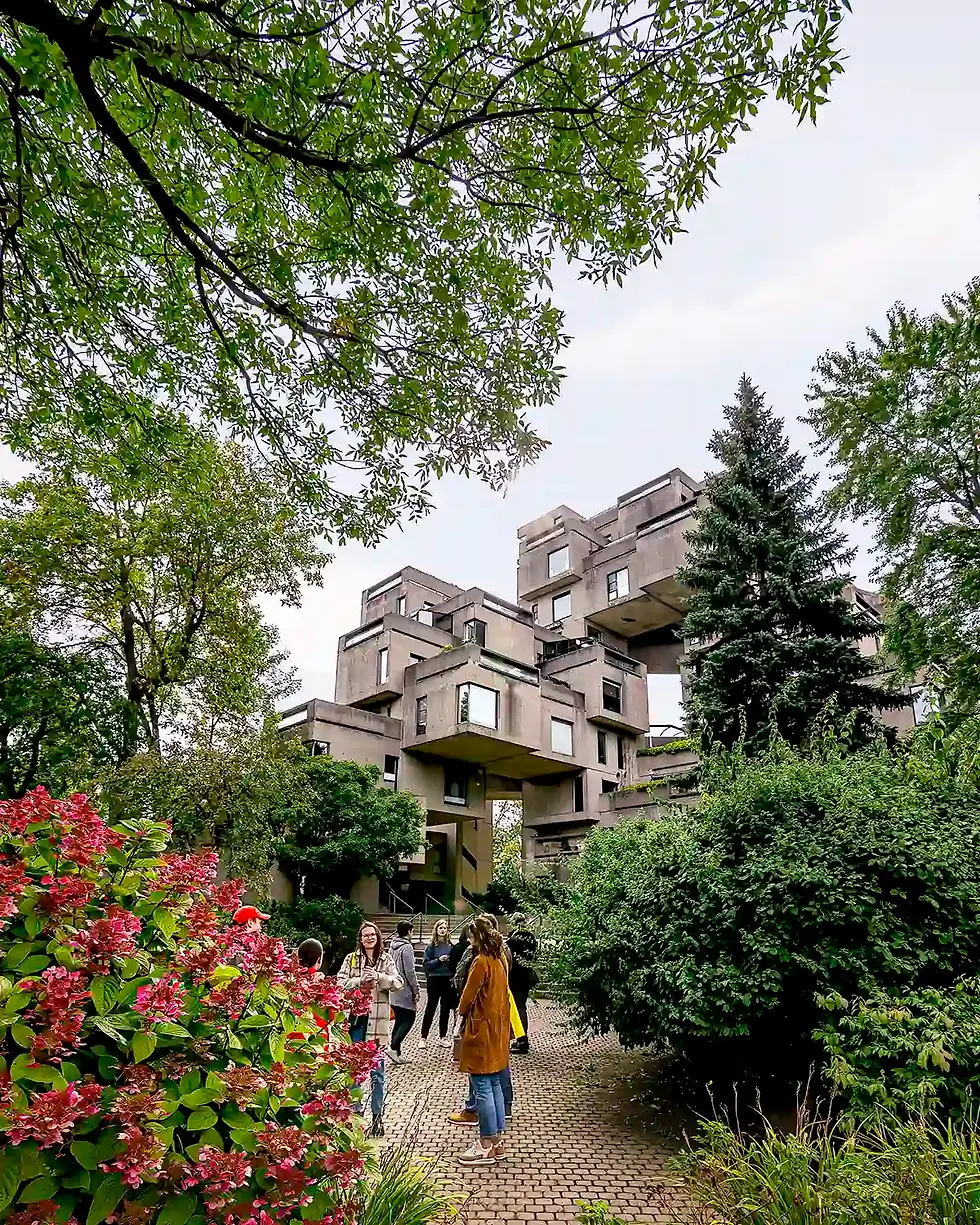
Don't miss Habitat 67, Moshe Safdie's visionary housing complex, created for Expo 67, which remains strikingly futuristic nearly sixty years later. The interlocking concrete boxes, each a private residence with terraces and gardens, reimagined urban density in ways architects still study. Though you can't enter the private homes, viewing the complex from the waterfront reveals its radical ambition.
And then there's Mount Royal itself—the hill that gives the city its name. Frederick Law Olmsted, the designer of Central Park, laid out the park in 1876. Although his original vision was altered during implementation, the result remains Montréal's green heart. Sunday afternoons bring tam-tam drummers to the eastern slopes, while the Kondiaronk Belvedere offers panoramic views over downtown. In every season, Montrealers climb the mountain paths—to ski in winter, cycle in summer, or simply breathe air above the city.
The practicals

The airport sits just twenty to thirty minutes from downtown, depending on traffic. Montréal is the perfect destination for a long weekend: culturally rich, walkable, and deliciously layered.
Spring brings the best mix of mild weather and festivals, with May and June seeing the city burst into leaf and blossom, accompanied by an explosion of outdoor café culture. Autumn matches spring's appeal, as September and October paint Mount Royal in theatrical colours and harvest ingredients flood Jean-Talon Market. Winter, though demanding, offers an intimate, beautifully lit cityscape where locals embrace the season rather than merely endure it. Summer can be humid, but the city compensates with outdoor theatre, rooftop bars, and a permissive attitude toward late-night revelry.
Consider buying a Passeport MTL for discounted access to museums and attractions, and don't miss a sunset walk along the Lachine Canal, where the old industrial waterway has been transformed into a linear park.


