


Barcelona 2026: Gaudí, Cerdà and the World’s Architectural Capital

Updated: Jan 26
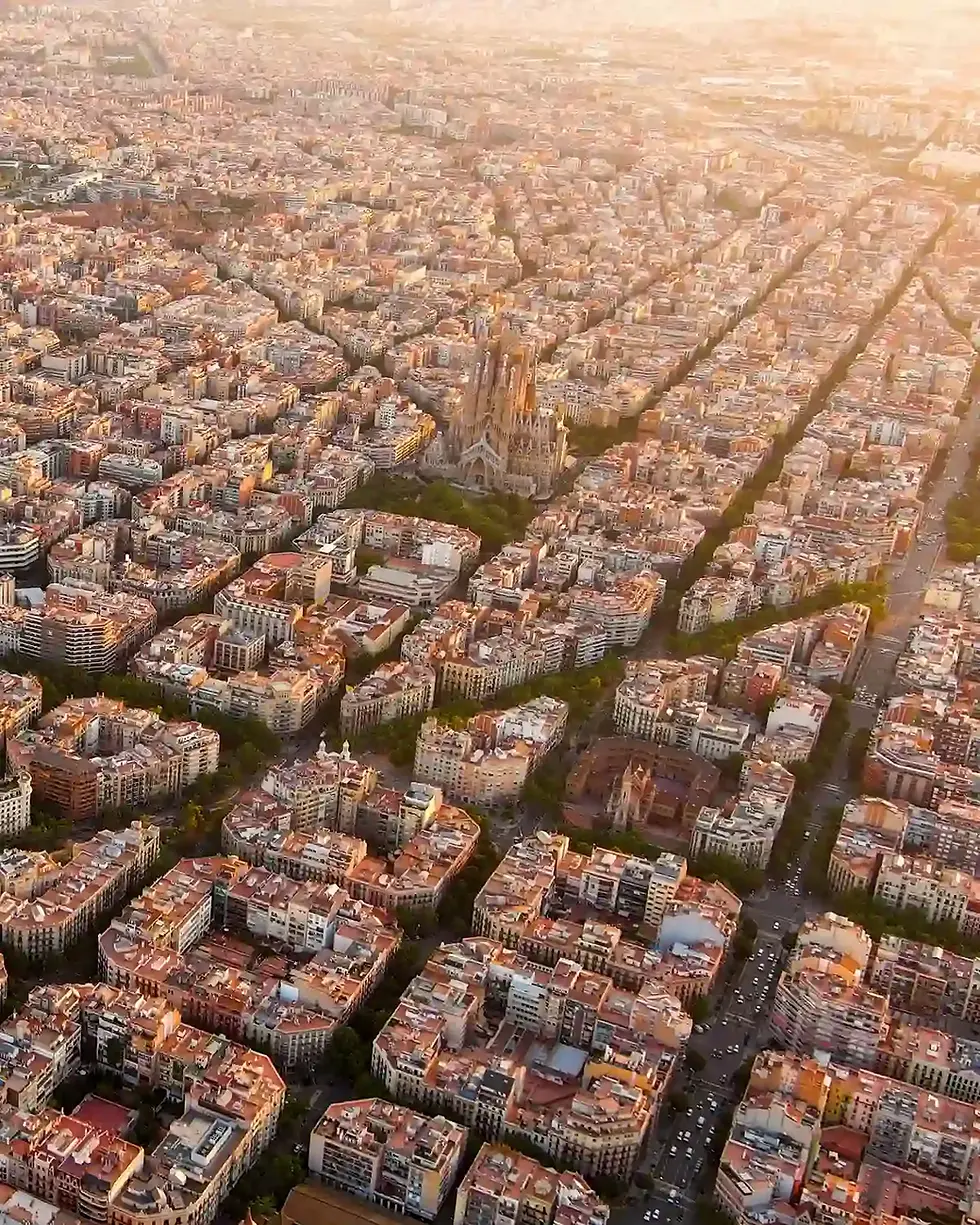
Few cities can be read as clearly through the lives of two individuals as Barcelona can. In 2026, the Catalan capital honours Antoni Gaudí, the architect whose imagination reshaped the language of architecture, and Ildefons Cerdà, the engineer–urbanist who provided the structural logic for a modern city. Together, they represent two forces that continue to define Barcelona.
Read more about Barcelona
Antoni Gaudí (1852–1926) rejected straight lines, historical imitation and rigid rules. Inspired by nature, geometry and faith, he developed an architectural language based on structural necessity rather than decoration. His buildings rely on catenary arches, inclined columns and complex geometries calculated through physical models, anticipating digital design by decades. One hundred years after his death, Gaudí’s work is increasingly read through contemporary lenses such as sustainability, biomimicry and experiential architecture.
Ildefons Cerdà (1815–1876), by contrast, approached the city analytically. His Eixample plan was revolutionary in its focus on public health, equality and mobility. Wide streets, green courtyards and chamfered corners were designed to maximise sunlight, ventilation and social interaction. In 2026, marking 150 years since Cerdà’s death, Barcelona highlights how visionary planning can shape everyday life as profoundly as iconic buildings.
As the UNESCO World Capital of Architecture, Barcelona will host ten months of exhibitions, conferences and public events in 2026. For visitors, the city becomes an open textbook of architectural ideas spanning centuries.
Here are 15 architectural masterpieces:
Sagrada Família – Gaudí’s Unfinished Testament

The Sagrada Família is Antoni Gaudí’s lifelong experiment and spiritual legacy. He devoted the final 15 years of his life entirely to this project, transforming it into a synthesis of architecture, theology, mathematics and nature. Gaudí believed the building should function as a “Bible in stone”, readable through form, proportion and symbolism rather than words.
The three monumental façades represent the Nativity, the Passion and the Glory, each conceived as an emotional narrative carved into stone. Inside, the forest-like nave rises on branching columns whose geometry follows precise mathematical rules derived from nature. Light enters through coloured glass with deliberate chromatic symbolism, shifting mood throughout the day.
For architecture enthusiasts, the Sagrada Família is a landmark in structural innovation: ruled surfaces, hyperboloids, helicoids and catenary arches were all calculated manually by Gaudí using hanging models. By 2026, the centenary of his death, major phases of the construction are expected to be complete, making this jubilee year a historic moment to experience the building in near-finished form.
Address: Carrer de Mallorca, 401
Public transport: Metro L2 or L5 – Sagrada Família
Website: https://sagradafamilia.org
Casa Batlló – A Living Organism on Passeig de Gràcia

Casa Batlló is often described as one of the most imaginative private houses ever built. Remodelled by Gaudí in 1904–1906, the building almost entirely abandons straight lines. The façade appears fluid, with ceramic fragments shimmering like fish scales and balconies resembling skeletal masks.
Beyond its visual drama lies a deeply rational interior. Gaudí redesigned the building to optimise natural ventilation, daylight and movement, long before sustainability became a design concept. A central light well widens towards the top to ensure even illumination, while doors, handrails, and windows are ergonomically shaped for human use.
For visitors in 2026, Casa Batlló offers a layered experience: immersive digital storytelling explains the architectural logic behind the fantasy, making it equally rewarding for casual tourists and design specialists.
Address: Passeig de Gràcia, 43
Public transport: Metro L2, L3, L4 – Passeig de Gràcia
Website: https://www.casabatllo.es
Casa Milà – A Radical Vision of Urban Living

Completed in 1912, Casa Milà was Gaudí’s final private commission and one of his most controversial. Nicknamed La Pedrera, the stone quarry, by critics, the building rejected symmetry, ornamentation and conventional structure.
Its most revolutionary feature is the absence of load-bearing interior walls, allowing apartments to be freely reconfigured — a concept decades ahead of its time. The undulating stone façade functions as a continuous skin, while iron balconies twist organically across the surface.
The rooftop is a sculptural landscape where chimneys and ventilation towers resemble abstract warriors. Beneath it, the attic houses an exhibition explaining Gaudí’s experimental structural methods, making Casa Milà essential viewing for anyone interested in architectural innovation.
Address: Passeig de Gràcia, 92
Public transport: Metro L3 or L5 – Diagonal
Website: https://www.lapedrera.com
Park Güell – Architecture Grown from the Earth

Originally planned as a residential garden city inspired by British models, Park Güell never fulfilled its commercial purpose. Instead, it became one of the most poetic public spaces in Europe.
Gaudí integrated architecture directly into the landscape, shaping columns to resemble tree trunks and viaducts that follow the contours of the hillside. Materials were sourced locally, and surfaces were designed to drain rainwater naturally, demonstrating early environmental thinking.
The famous serpentine bench, covered in trencadís mosaic, is ergonomically designed to fit the human body while framing panoramic views of Barcelona. For urban planners and architects, Park Güell remains a seminal study in blending infrastructure, landscape and public life.
Address: Carrer d’Olot, 5
Public transport: Metro L3 – Lesseps (walk uphill)
Website: https://parkguell.barcelona
Palau Güell – Power, Darkness and Vertical Drama

Located just off La Rambla, Palau Güell reveals a lesser-known side of Gaudí. Built as a city residence for industrialist Eusebi Güell, the palace is compact yet intensely dramatic.
The exterior is restrained, almost severe, but the interior unfolds vertically around a towering central hall designed for musical performances and social gatherings. Light filters down through a parabolic dome perforated with small openings, creating a theatrical atmosphere.
On the rooftop, chimneys explode into colour and form, foreshadowing Gaudí’s later, more expressive works. For architectural historians, Palau Güell is crucial in tracing Gaudí’s transition from historicism to radical modernism.
Address: Carrer Nou de la Rambla, 3–5
Public transport: Metro L3 – Liceu
Website: https://www.palauguell.cat
Hospital de Sant Pau – A Monument to Human-Centred Design

Designed by Lluís Domènech i Montaner, the Hospital de Sant Pau redefines what institutional architecture can be. Rather than a single massive structure, the hospital consists of individual pavilions arranged within gardens and connected by underground tunnels.
This layout was revolutionary, promoting light, fresh air and psychological well-being as part of medical treatment. Rich decoration, ceramic tiles and symbolic sculpture elevate the complex beyond pure function.
Today, the restored site serves as a cultural and educational centre, offering insight into Modernisme beyond Gaudí and demonstrating how architecture can improve the quality of life.
Address: Carrer de Sant Antoni Maria Claret, 167
Public transport: Metro L5 – Sant Pau | Dos de Maig
Website: https://santpaubarcelona.org
Palau de la Música Catalana – When Architecture Becomes Music

The Palau de la Música Catalana is one of the world’s most extraordinary concert halls and a masterpiece of Catalan Modernisme. Built with a pioneering steel structure, it allowed walls to dissolve into glass, flooding the interior with light.
The stained-glass skylight, shaped like an inverted dome, transforms daylight into an architectural performance. Every surface is symbolic, celebrating Catalan culture, folklore and musical tradition.
For visitors, guided tours reveal how structure, acoustics and ornamentation work together. For professionals, the Palau stands as a landmark in combining engineering innovation with artistic expression.
Address: Carrer del Palau de la Música, 4–6
Public transport: Metro L1 or L4 – Urquinaona
Website: https://www.palaumusica.cat
Casa Vicens – The Birth of a Radical Architectural Language

Casa Vicens is where Gaudí’s architectural voice first becomes unmistakable. Built between 1883 and 1885 as a summer house, the building already rejects academic historicism in favour of bold colour, surface pattern and handcrafted detail. Ceramic tiles inspired by local flora, Moorish-inspired geometry and strong horizontal lines give the house a graphic intensity that feels remarkably contemporary.
For visitors, Casa Vicens offers a more intimate Gaudí experience than his later, monumental works. Rooms are compact, richly detailed and human-scaled. For architecture enthusiasts, it is a crucial reference point: here we see Gaudí experimenting with ornament as structure, integrating decorative arts into the architectural whole, and testing ideas he would later develop on a far grander scale.
The meticulous restoration allows close study of materials, joinery and colour theory, making Casa Vicens essential for anyone interested in the origins of Modernisme.
Address: Carrer de les Carolines, 20–26
Public transport: Metro L3 – Fontana
Website: https://casavicens.org
Torre Glòries – Barcelona Looks Up

Formerly known as Torre Agbar, Torre Glòries marks a decisive shift from Barcelona’s historic horizontality to a vertical, contemporary skyline. Designed by French architect Jean Nouvel in collaboration with Fermín Vázquez, the tower was conceived as a symbol of 21st-century Barcelona: innovative, technological and globally connected, yet rooted in local references.
Its bullet-like form is often linked to the peaks of Montserrat, while the façade’s double skin combines glass and aluminium panels that respond to temperature and light. At night, more than 4,500 LED devices transform the building into a luminous urban beacon. Inside, exhibitions explain how the tower fits into Barcelona’s post-industrial transformation of the Glòries district, once a traffic-dominated no-man’s land, now a growing cultural and innovation hub.
For visitors, Torre Glòries offers panoramic views and interactive displays. For architecture enthusiasts, it stands as a case study in climate-responsive façades and symbolic high-rise design in a city traditionally sceptical of towers.
Address: Avinguda Diagonal, 211
Public transport: Metro L1 – Glòries
Website: https://www.torreglories.com
Mies van der Rohe Pavilion – Radical Simplicity

Few buildings have influenced modern architecture as profoundly as the Mies van der Rohe Pavilion. Originally built as the German Pavilion for the 1929 International Exposition, it was dismantled shortly afterwards and reconstructed in the 1980s as an exact replica on its original site.
The pavilion is deceptively simple: a composition of planes rather than walls, where space flows freely between interior and exterior. Luxurious materials such as green marble, travertine and onyx are used not ornamentally but structurally, reinforcing Mies’ famous principle of “less is more”. The building rejects traditional ideas of monumentality, yet has become one of the most photographed and studied works of modern architecture.
For architects and students, visiting the pavilion is a pilgrimage. For general visitors, it offers a calm, meditative contrast to Barcelona’s exuberant Modernisme.
Address: Avinguda Francesc Ferrer i Guàrdia, 7
Public transport: Metro L1 or L3 – Espanya
Website: https://miesbcn.com
Eixample – Cerdà’s City as a Living System

The Eixample district is one of the most ambitious urban experiments ever realised. Designed by Ildefons Cerdà in the mid-19th century, it was intended to solve the overcrowding, poor sanitation and social inequality of the old city. Rather than monumental architecture, Cerdà focused on systems: circulation, light, air and social interaction.
The grid’s chamfered corners improve visibility and airflow, while the original plan envisioned green courtyards inside each block, communal spaces and equal access to services. Although later development compromised some of these ideals, Eixample remains remarkably resilient and adaptable.
For travellers, Eixample offers elegant streets, cafés and shops. For urbanists, it is a functioning textbook on how planning shapes everyday life, making it one of Barcelona’s most important architectural experiences.
Address: Eixample district
Public transport: Multiple metro lines
Website: https://ajuntament.barcelona.cat
Casa Amatller – Modernisme with Northern Precision

Standing beside Gaudí’s Casa Batlló, Casa Amatller often surprises visitors with its contrasting aesthetic. Designed by Josep Puig i Cadafalch, it reflects a more rational and historically grounded strand of Catalan Modernisme, drawing inspiration from Gothic architecture and Northern European townhouses.
Commissioned by chocolatier Antoni Amatller, the building combines a stepped gable façade with lavish interior decoration, including stained glass, woodwork and ceramic details. Unlike many modernist houses, Casa Amatller preserves much of its original furniture and decorative arts, offering an unusually complete snapshot of bourgeois life at the turn of the 20th century.
For architecture lovers, it highlights the diversity within Modernisme itself.
Address: Passeig de Gràcia, 41
Public transport: Metro – Passeig de Gràcia
Website: https://amatller.org
Mercat de Sant Antoni – Architecture for Everyday Life


Originally opened in 1882, Mercat de Sant Antoni is a monumental iron structure designed by Antoni Rovira i Trias, demonstrating how industrial materials reshaped civic architecture. Recently restored after a decade-long project, the market now integrates archaeological remains, public space and contemporary retail.
The renovation carefully balances heritage preservation with modern needs, turning the market into a social anchor for the surrounding neighbourhood. Its scale, symmetry and structural clarity make it one of the finest examples of 19th-century market architecture in Europe.
For visitors, it is a place to eat, browse and observe daily life. For architecture enthusiasts, it illustrates how infrastructure can be both functional and dignified.
Address: Carrer del Comte d’Urgell, 1
Public transport: Metro L2 – Sant Antoni
Website: https://www.mercatdesantantoni.com
Museu del Disseny de Barcelona – Design as Identity

Housed in a striking contemporary building at Plaça de les Glòries, the Museu del Disseny de Barcelona represents the city’s commitment to design as a cultural and economic force. Its angular form reflects the surrounding urban transformation while asserting a clear institutional presence.
Inside, collections span industrial design, fashion, graphic design and decorative arts, linking historical craftsmanship with contemporary practice. The museum positions Barcelona not only as a city of architectural heritage, but as a living design laboratory.
For travellers, it offers insight into the city’s creative DNA. For professionals, it provides context for Barcelona’s global reputation in design and innovation.
Address: Plaça de les Glòries Catalanes, 37–38
Public transport: Metro L1 – Glòries
Website: https://www.dissenyhub.barcelona
Montjuïc Olympic Ring – Architecture of Reinvention

The Montjuïc Olympic Ring tells the story of Barcelona’s modern transformation. Developed for the 1992 Olympic Games, the area combines restored historic venues with bold contemporary interventions, including the Olympic Stadium by Vittorio Gregotti and the telecommunications tower by Santiago Calatrava.
Montjuïc became a catalyst for urban renewal, reconnecting the city with the sea and redefining Barcelona’s international image. Today, the area remains active, hosting events, exhibitions and public life.
For architecture enthusiasts, Montjuïc demonstrates how large-scale events can leave lasting, positive urban legacies when guided by coherent planning.
Address: Montjuïc hill
Public transport: Metro L1 or L3 – Espanya
Website: https://www.barcelona.cat
Getting to Barcelona
By Air
Barcelona–El Prat Airport (BCN) is one of Europe’s busiest hubs, served by most major international and European airlines. It lies around 15 kilometres southwest of the city centre.
Aerobús: The fastest and most convenient option to go from the airport to the city centre. Runs every 5–10 minutes to Plaça de Catalunya (around 35 minutes).
Train (R2 Nord): Connects the airport to Sants, Passeig de Gràcia and Clot.
Metro: Line L9 Sud connects the airport to the wider metro network.
Taxi: Fixed airport supplement; journey time 25–35 minutes depending on traffic.
By Train
Barcelona is well connected by high-speed AVE trains from Madrid (around 2.5–3 hours), as well as international services from France. Barcelona Sants is the main station, with direct metro connections.
Getting Around the City
Barcelona is one of Europe’s easiest cities to navigate, especially for architecture-focused travellers.
Public Transport
Metro: Extensive, reliable and inexpensive. Most architectural landmarks are within walking distance of a metro stop.
Buses: Useful for cross-city routes and Montjuïc.
Trams: Limited network but efficient in newer districts.
Tip: Multi-day travel cards (T-casual or Hola Barcelona) offer excellent value.
Walking
Barcelona is exceptionally walkable, particularly Eixample, El Born, Gràcia and the waterfront. Walking is often the best way to understand Cerdà’s grid and street proportions.
Cycling
Bike lanes are widespread, and public bike-sharing and rental schemes are easy to use. Flat terrain makes cycling practical for most visitors.
Taxis & Ride-hailing
Taxis are plentiful and reasonably priced. Ride-hailing services also operate, though taxis remain the most reliable option.
General Tips for Travellers
Book Ahead
Gaudí landmarks such as Sagrada Família, Casa Batlló and La Pedrera often sell out days in advance.
Respect the City
Barcelona is actively managing tourism pressure. Respect residential areas, follow signage, and support local businesses beyond the main sights.
Dress Code
Churches such as Sagrada Família require covered shoulders and knees. Comfortable footwear is essential for stone floors and long walks.


