


This is Europe's new weekend hotspot

Updated: Jul 26

Bosnia´s capital has its share of heavy chapters, but today's Sarajevo is a city buzzing with craft coffee bars, rooftop terraces, and a food scene that punches way above its weight – all at prices that make your wallet happy.
Here you'll eat the best cevapi of your life for a few quid, ride a cable car up to mountain viewpoints, and wander through a bazaar that's been trading for 500 years – but now with boutique shops and third-wave espresso tucked between the coppersmith workshops.
Yes, the history is there. You can't miss it, and you shouldn't. But the city that hosted the 1984 Winter Olympics and then survived nearly 4 years of siege has rebuilt itself into something vibrant, confident, and genuinely cool. Young creatives are opening galleries. The nightlife is thriving. And the café culture? Described by many as the best in the Balkans.
The best bit? Sarajevo is still flying under the radar. It's affordable, wildly photogenic, and refreshingly free of the crowds choking other European hotspots. Here are twelve must-sees and do's in Sarajevo.
Get lost (on purpose) in Bascarsija

Sarajevo's old bazaar is a working city centre where crafts, cafés, and grills overlap.
Bascarsija was founded in the 15th century when the Ottomans established Sarajevo as a trading hub. The name comes from the Turkish word for "main market," and that's exactly what it still is – a maze of narrow lanes lined with workshops, mosques, and tiny storefronts selling everything from handmade copperware to tourist trinkets.
This is also where you'll feel Sarajevo's East–West identity most clearly. Ottoman-era street patterns give way to Austro-Hungarian edges just a few blocks west. Minarets rise above tiled rooftops. A call to prayer drifts over the clink of coffee cups. And threading through it all, modern Sarajevans go about their day – grabbing burek for breakfast, meeting friends for a macchiato, arguing about football.
Start at Sebilj, the wooden fountain at the heart of the bazaar, and wander without a plan. Duck into a courtyard. Try a cevapi. Watch a coppersmith work. There's no wrong turn here.
Tip: Come twice—once in the morning and once at night to experience the different vibes.
Step inside Gazi Husrev-beg Mosque (and do it respectfully)

This is one of the great Ottoman monuments in the Balkans, and it still functions as a living religious space.
Completed in 1531, Gazi Husrev-beg Mosque is the largest historical mosque in Bosnia and Herzegovina, and one of the finest examples of classical Ottoman architecture outside Turkey. Its designer was Mimar Sinan's school – the same tradition that produced Istanbul's greatest mosques – and the elegance shows: a graceful central dome, a slender minaret, and an interior bathed in soft light from rows of arched windows.
For nearly 500 years, it has been the spiritual heart of Sarajevo's Muslim community – through Ottoman rule, Austro-Hungarian administration, two world wars, Yugoslav socialism, and the 1990s siege. The mosque was damaged by shelling during the war but has been carefully restored. Today, it remains fully active: locals come here to pray five times a day, just as they have for centuries.
Visitors are welcome outside prayer times. Dress modestly (headscarves are available for women at the entrance), remove your shoes, and speak quietly. Give yourself a few minutes to sit inside – Sarajevo's noise drops away in an instant.
Address: Saraci 8, 71000 Sarajevo
Visit Vijecnica, Sarajevo's City Hall

Built in 1896 during Austro-Hungarian rule, Vijecnica was designed to be a showpiece: a blend of Islamic geometric patterns and European grandeur. It served as Sarajevo’s city hall for decades before later becoming the National Library, housing nearly two million books, rare manuscripts, and irreplaceable archives.
On the night of 25 August 1992, Bosnian Serb forces deliberately targeted Vijećnica with incendiary shells. The building burned for three days. Librarians and volunteers formed human chains to rescue what they could, while snipers fired on them from the hills. Despite their efforts, around 90 per cent of the collection was destroyed – centuries of Bosnian history, literature, and memory reduced to ash.
The ruins stood empty for over two decades, a blackened skeleton on the riverfront. Then, in 2014 Vijecnica reopened after a painstaking reconstruction. Today, the interior gleams again: the grand staircase, the stained glass, the ornate ceilings, all meticulously restored.
Go for the architecture; stay for the story of what the building represented, why it was targeted, and why rebuilding it mattered so much.
Address: Obala Kulina bana 1, 71000 Sarajevo
Website: vijecnica.ba
Cross the Latin Bridge and visit the Museum Sarajevo 1878–1918
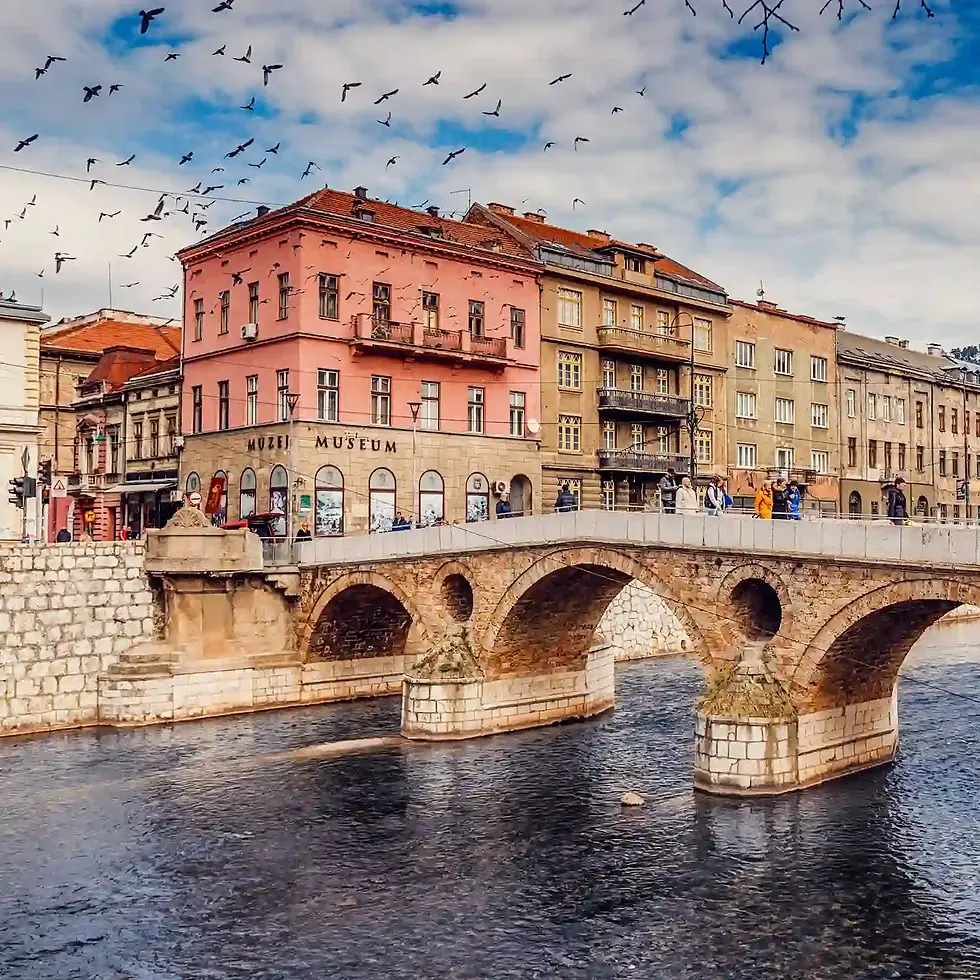
The Latin Bridge is one of Sarajevo's oldest river crossings, dating back to the Ottoman period. On the north bank of the river, you're standing at one of modern history's fault lines.
It was here, on 28 June 1914, that a teenage Bosnian Serb nationalist named Gavrilo Princip shot Archduke Franz Ferdinand, heir to the Austro-Hungarian throne, and his wife Sophie. The assassination set off a diplomatic chain reaction that, within weeks, engulfed Europe in war. Empires would fall. Millions would die.
Today the Museum Sarajevo 1878–1918 occupies the corner building next to the Latin Bridge. When Austria-Hungary took control of Bosnia in 1878, Sarajevo was a provincial Ottoman town of around 25,000 people. Within a few decades, the new rulers had imposed a dramatic makeover: grand public buildings, paved boulevards, electric trams, and an administrative system designed to pull the region into Central European modernity.
Inside the museum, you'll see how Sarajevo's residents navigated life under various rulers, how Ottoman and Austro-Hungarian influences blended in architecture and culture, and how the city became a flashpoint for tensions that would engulf the continent.
Address: Zelenih beretki 1, 71000 Sarajevo
War Childhood Museum: Sarajevo's most quietly devastating museum

If you visit just one war-related museum, make it this one. It focuses on how conflict reshapes childhood from the inside out. It's intimate and hard to forget.
The museum grew from a simple question: what object from your childhood during the war would you bring? Author Jasminko Halilovic posed it to Bosnians who had grown up during the siege, and the responses became first a book, then this museum. Each display pairs an everyday item – a pencil case, a dented spoon, a UN ration tin – with a short personal testimony from its owner.
These are mundane objects: a toy, a piece of clothing, a cassette tape. But the stories attached to them are anything but. A deck of cards was used to pass the time in a basement shelter. A pair of shoes worn on a dangerous sprint across Sniper Alley. A schoolbook finished by candlelight during power cuts. Together, they build a portrait of childhood interrupted – resilience, fear, boredom, loss, and small moments of joy, all tangled together.
Address: Logavina 32, 71000 Sarajevo
Website: warchildhood.org
Gallery 11/07/95: a memorial space that hits like a wave

This gallery is dedicated to the remembrance of Srebrenica.
The name marks the date: 11 July 1995, when Bosnian Serb forces overran the UN-declared "safe area" of Srebrenica. In the days that followed, more than 8,000 Bosniak men and boys were systematically murdered – the worst mass atrocity in Europe since the Second World War.
Gallery 11/07/95 doesn't sensationalise. Instead, it bears witness through photography, video testimony, and some personal objects. The main exhibition features the work of Tarik Samarah, whose stark black-and-white images document the aftermath, the exhumations, and the annual burials that continue to this day as newly identified remains are laid to rest. Screens play interviews with survivors and families. The scale of loss becomes personal, one face at a time.
Address: Trg fra Grge Martica 2/III, 71000 Sarajevo
Website: galerija110795.ba
Tunnel of Hope: the city's lifeline under siege

From 1992 to 1995, Sarajevo was surrounded by hostile forces. The city's only link to the outside world was a UN-controlled runway at the airport – crossing it meant risking sniper fire. So Sarajevans dug. In just four months, working from both ends with hand tools and sheer determination, they carved an 800-metre tunnel beneath the runway, connecting the besieged city to free territory on the other side.
Through this narrow passage – just 1.6 metres high and one metre wide – came everything a city under siege needed to survive: food, medicine, fuel, weapons, and hope. Tons of supplies passed through. So did thousands of people, including wounded civilians, soldiers, and journalists. For nearly three years, this cramped tunnel was Sarajevo's jugular vein.
Today, around 25 metres of the original tunnel remain open to visitors, accessed through the house that served as its secret entrance. The small museum displays photos, equipment, and personal stories from the siege years. Walking through the tunnel section – hunched, in dim light – gives you just a glimpse of what Sarajevans endured daily.
Address: Tuneli 1, Ilidza – Donji Kotorac (Sarajevo area) Website: tunelspasa.ba
National Museum of Bosnia and Herzegovina: the "deep time" reset

National Museum of Bosnia and Herzegovina: the "deep time" reset
After Sarajevo's intense 20th century, this is your long view – a reminder that Bosnia and Herzegovina has been home to human settlement for tens of thousands of years, and that its story stretches far beyond the headlines.
Founded in 1888 during the Austro-Hungarian period, the National Museum is the country's oldest and most important cultural institution. Its four pavilions surround a peaceful botanical garden, and the collections span archaeology, ethnology, and natural history. You'll find Neolithic artefacts, Roman tombstones, medieval jewellery, and traditional crafts from Bosnia's villages – layer upon layer of civilisation, long before empires and wars reshaped the map.
The star attraction is the original Sarajevo Haggadah, the 14th-century illuminated Jewish manuscript that survived the Spanish Inquisition, the Second World War, and the 1990s siege. It's displayed in its own secure room – a single, fragile book that carries centuries of history and resilience.
The museum itself has a story worth knowing. It closed for several years after the war due to funding disputes and political neglect, only reopening in 2015 after staff worked unpaid to keep it alive. Today it's fully operational again – a quiet act of defiance and dedication.
Give yourself a couple of hours to wander. It's the perfect antidote to the emotional weight of Sarajevo's war museums, and a chance to see this corner of Europe in its full, ancient context.
Address: Zmaja od Bosne 3, 71000 Sarajevo Website: zemaljskimuzej.ba Tip: Check Monday closures (the museum notes it's closed Mondays).
The Jewish Museum: Sarajevo's multicultural story, told precisely

Sarajevo is sometimes called "the Jerusalem of Europe" – and this small but powerful museum explains why.
Housed in the Old Sephardic Synagogue from 1581, the museum traces Jewish life in Bosnia from the arrival of Sephardic refugees fleeing the Spanish Inquisition through centuries of coexistence to the tragedy of the Holocaust. You'll find religious artefacts, traditional clothing, and documents that bring the community's daily life into focus. Among the treasures is a copy of the Sarajevo Haggadah, the 14th-century illuminated manuscript that survived both the Second World War and the 1990s siege.
The museum also shows how four faiths – Islam, Catholicism, Orthodox Christianity, and Judaism – shared the same streets and markets for over 500 years. Today, Sarajevo's Jewish community numbers just a few hundred, but this museum keeps their story visible and vital.
Address: Velika Avlija bb, Sarajevo
Website: muzejsarajeva.ba
Yellow Fortress at sunset: Sarajevo's best skyline moment

You climb a little, you sweat a little, and then the whole city opens up: minarets, rooftops, the river ribbon, and mountains framing everything. This is Sarajevo's signature viewpoint. In the evenings, the fortress walls fill with couples, friends, and families watching the light fade over the valley.
The Yellow Fortress (Zuta Tabija) dates back to the 18th century, when it formed part of the city's Ottoman-era defences. Today, the cannons are long gone, but the wide stone terrace remains. From here, you can pick out all four of Sarajevo's historic places of worship, trace the Miljacka River winding through the old town, and watch the surrounding hills turn gold, then pink, then purple.
There's a small café nearby if you need refreshments, but most visitors bring their own drinks and snacks. The atmosphere is relaxed and unpretentious.
Trebevic cable car + Olympic bobsleigh track: nature, views, and a strange relic

Sarajevo's most satisfying "two-in-one" outing: take the cable car up to Mt. Trebevic, then walk to the abandoned Olympic bobsleigh track – now reclaimed by graffiti, trees, and hikers. It's eerie, scenic, and uniquely Sarajevo.
The original cable car was a symbol of Sarajevo's Olympic moment – modern, ambitious, connecting the city to its mountain playground in minutes. It was destroyed during the siege, when Trebevic became a front line. In 2018, a new cable car opened, and Sarajevans reclaimed their hill.
Today, the nine-minute ride lifts you 600 metres above the city, with views that just keep expanding as you rise. At the top, marked hiking trails fan out through pine forest – but the main draw for most visitors is the bobsleigh track. Built for the 1984 Winter Games, the track once hosted world-class athletes hurtling down at 130 km/h. Now it's a concrete snake winding through the woods, its walls covered in street art, its curves slowly being swallowed by vegetation.
You can walk the full length of the track, ducking through tunnels and climbing the banked corners. It's part urban exploration, part nature walk, part open-air memorial to a city that has lived several lives. Bring water, wear sturdy shoes, and give yourself a couple of hours to explore.
Bonus: One more panorama—Avaz Twist Tower

If you want a modern, glossy viewpoint to contrast the fortress-and-minaret skyline, this is it. The Avaz Twist Tower is Bosnia and Herzegovina's tallest building – a 176-metre glass skyscraper that twists gently as it rises, giving Sarajevo a slice of 21st-century swagger.
Built in 2008 as the headquarters for the Dnevni Avaz newspaper, the tower's observation deck offers 360-degree views. Up here, you see Sarajevo as a modern capital: sprawling suburbs, tower blocks, shopping centres, and the Olympic mountains beyond. It's a useful reminder that this city isn't frozen in history – it's building, growing, and looking forward.
There's a small café at the top if you want to linger. On a clear day, you can see for miles – the perfect way to get your bearings on arrival or say goodbye before heading to the airport.
Address: Tesanjska 24a, 71000 Sarajevo
Website: avaztwisttower.ba
How to get there
By air: Fly into Sarajevo International Airport (SJJ). From the airport to the centre, the tourist board notes a direct airport bus with published departure times; tickets are priced in BAM/KM.
Airport to town: Airport bus (Centrotrans): Runs to key downtown points.
Taxi: Quick and convenient—confirm the fare before you get in or insist on the meter.
Getting around
Sarajevo is built for walking, but you'll use the tram at least once—partly for convenience, partly because it's the city's moving stage set.
The Practicals
Money: Bosnia and Herzegovina uses the Convertible Mark (BAM/KM). Carry some cash for small purchases and tickets.
Tipping: Common in cafés and restaurants; rounding up or around 5–10% is typical when service is good.


