


The Long Road from Barcelona to Madrid

Updated: Jul 26
ROAD TRIP | SPAIN

The fastest way from Barcelona to Madrid is a 620-kilometre straight shot down the A-2 motorway. It is flat, efficient, and almost entirely forgettable. Don't do it.
Spain's interior is one of Europe's great undiscovered road trip canvases: Roman ruins crumbling into dry riverbeds, medieval towns hovering above gorges, ghost villages frozen in the amber of the Civil War, and cathedrals so baroque they seem to be shouting at the sky.
Spread this drive over three days, and you'll arrive in Madrid understanding something about Spain that the high-speed train passengers never will.
The route:
Barcelona → Sitges → Tarragona → Montblanc → Zaragoza (overnight) → Daroca → Belchite → Medinacelli → Sigüenza (overnight) → Guadalajara → Alcalá de Henares → Madrid
Distance:
Approximately 720 km with detours
For what to see and do in Barcelona, read our neighbourhood guide for the catalan capital:
Day One: Catalonia Unravels
Sitges
45 minutes from Barcelona
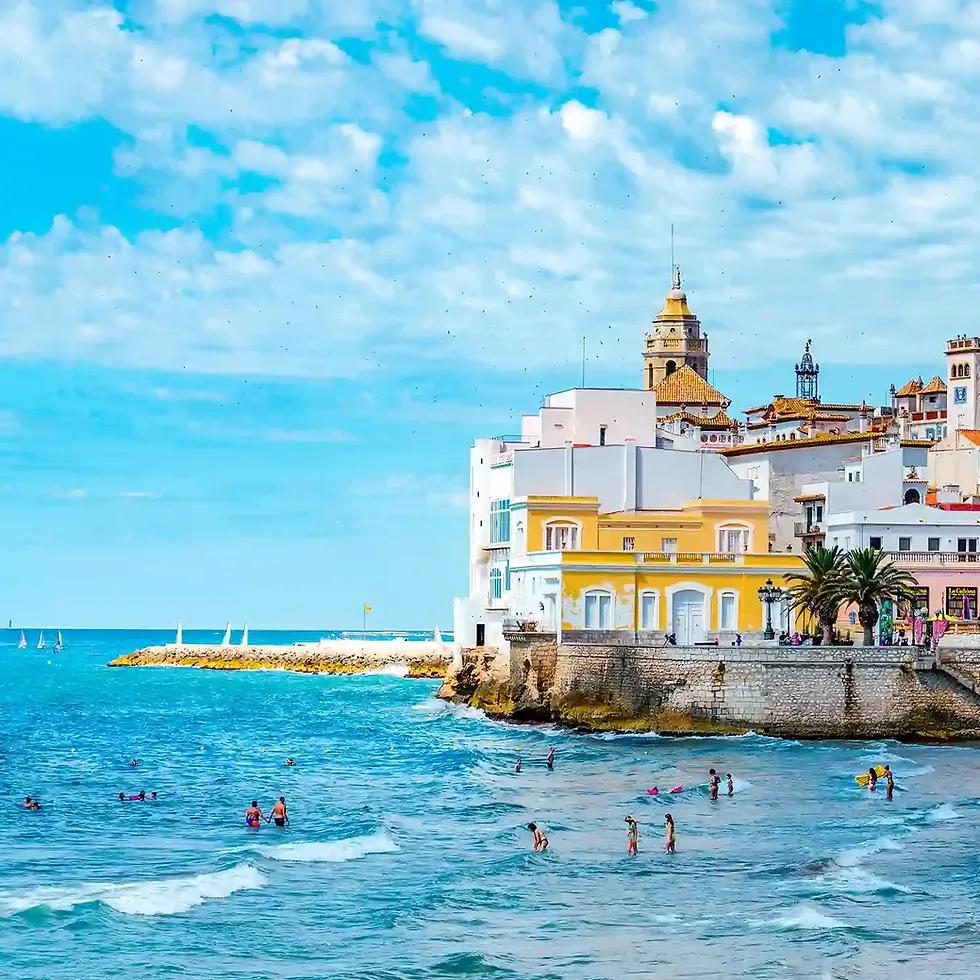
Leave Barcelona on the C-31 coastal road rather than the motorway, and your reward is immediate: the road hugs limestone cliffs above a blue Mediterranean that looks almost offensively beautiful. Sitges announces itself as a whitewashed town of considerable self-confidence — a resort with genuine soul, its seafront promenade lined with 18th-century mansions built by returning Americanos who made fortunes in Cuba and came home to show off about it.
Park near the old town and walk up to the Church of Sant Bartomeu i Santa Tecla, which sits on a headland above the sea like a punctuation mark. The Museu Cau Ferrat, once the studio of Symbolist painter Santiago Rusiñol, is home to an extraordinary private collection, including two El Grecos. The Museu Romantic next door offers a peculiar and wonderful window into 19th-century bourgeois life, with its rooms preserved in aspic, complete with original furniture, dolls, and clocks stopped at the hour their owners left.
The seafront promenade, the Passeig Marítim, is best in the morning before the beach crowds arrive — fishermen still mend nets on the sand below the old town, and the light on the white facades at nine in the morning is the kind of thing painters move here for. Have a coffee at one of the terrace cafés, let the morning slow down.
The restaurants along Carrer Major are reliable for a late breakfast of pa amb tomàquet, the Catalan staple of bread rubbed with ripe tomato and drizzled with olive oil, before getting back on the road south.
Tarragona
1 hour from Sitges
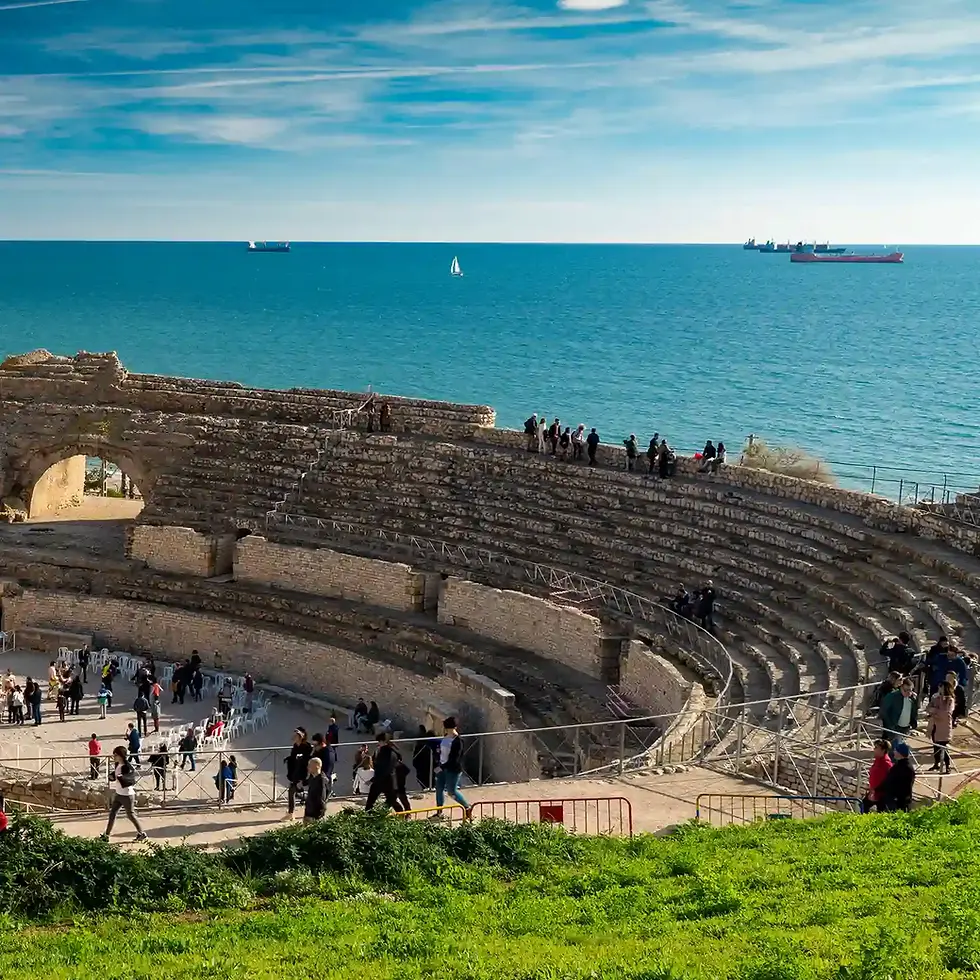
Tarragona's old town, Roman Forum, and Necropolis are among Spain's most impressive ancient sites, and the city doesn't oversell itself, which makes the impact stronger. This was Tarraco, the capital of Roman Hispania.
Walk the Passeig Arqueològic, a path that runs along the old Roman ramparts with views across the plain toward the sea. The walkway goes along the ramparts and offers scenic views of Tarragona below.
The amphitheatre sits directly on the coast, which gave condemned prisoners the unusual distinction of being able to watch the Mediterranean while being eaten by lions. It is one of the most dramatically sited Roman monuments in Europe, and it costs almost nothing to enter. The Forum, a short walk away, gives a clear sense of how large and organised Tarraco was at its height.
The medieval Cathedral of Tarragona, built on a Roman temple and a Visigoth church, is a layered palimpsest of two thousand years of faith. The cloister is exceptional, with carved capitals depicting scenes both biblical and frankly bizarre. Eat lunch in the Parte Alta, the old town above the Forum. The restaurants here are considerably better than they have any right to be, given the tourist footfall.
Montblanc
30 minutes from Tarragona

Montblanc is a remarkably well-preserved medieval town set in the foothills of the Prades Mountains, with its original stone walls still largely intact. The Bover Tower and St Jordi's Gate date back to the 13th century. It is the kind of place that makes you feel slightly guilty for not staying longer. Park outside the walls and walk in through one of the ancient gates. The streets are quiet, the scale is human, and life continues here with a comfortable indifference to the fact that the town looks like a film set.
The Gothic church of Santa Maria la Major dominates the interior: an ambitious, unfinished structure begun in the 14th century and still, six hundred years later, technically incomplete. The unfinished facade gives it a raw, honest quality. The local legend holds that Saint George slew his dragon just outside these very walls, which the town celebrates with considerable theatrical enthusiasm each April 23rd.
Less than ten kilometres away is the Monestir de Poblet, a Cistercian monastery and UNESCO World Heritage Site that served as the royal pantheon of the Crown of Aragon for two centuries. The kings of Aragon are buried here in elaborate Gothic tombs arranged in two rows in the presbytery. The drive through the vineyards of the Conca de Barberà to reach it is worth it alone.
Overnight Stop—Zaragoza

Zaragoza's Baroque Basilica Cathedral of Our Lady of the Pillar is one of the most important religious sites in Spain, and arriving in the city at dusk — when the cathedral's domes are lit against a darkening sky and reflected in the Ebro River — is one of those travel moments you file away permanently.
Where to stay: The NH Collection Zaragoza Gran Hotel occupies a 1920s landmark building on the Plaza de España, with rooms that retain the original Art Deco bones beneath modern comfort. For something smaller, the Palafox Hotel offers excellent Aragonese hospitality.
After check-in, head into El Tubo, the labyrinth of narrow streets in the old town that forms Zaragoza's legendary tapas district. This is not a tourist performance — it's where the city actually eats. Bar after bar lines the streets, each counter loaded with pintxos.
At the Plaza del Pilar, the vast esplanade fronting the basilica, locals are strolling, children running, and the cathedral's tiled domes are glowing under floodlights. Sit on the steps and watch the city inhabit its own grandeur with complete nonchalance.
Start your morning at the Aljafería Palace, an 11th-century Moorish fortress that later served as the home of the Spanish Inquisition. Now one of the best-preserved Islamic palaces outside Andalusia. The geometric stucco work in the throne room is breathtaking and completely at odds with the brutal history the building later witnessed. Allow two hours.
Francisco de Goya was born in a village 45 minutes from here, and the city claims him with considerable pride. Don't miss the Goya Collection at the Museo de Zaragoza. It includes etchings and portraits that reward even casual engagement with art. Then coffee and a torta de Zaragoza, a flaky, lard-enriched pastry, before getting back on the road.
Day Two: Aragon and Castile
Belchite
45 minutes south of Zaragoza

This is not an easy stop, but it is unforgettable. Old Belchite was the site of one of the bloodiest battles of the Spanish Civil War in 1937, a two-week siege in August heat that left the town destroyed and thousands dead on both sides. When Franco's forces eventually prevailed, he ordered a new town built nearby and left the rubble of the old one standing as a monument to his victory. This decision has accidentally created one of Europe's most haunting sites.
Access to Belchite is only possible via a guided tour from the local tourist office. The ruined church towers, collapsed houses, broken streets and shattered facades are silent in a way that feels loaded rather than merely empty. Take your time, and don't rush.
Daroca
1 hour from Belchite

Daroca is one of the most beautiful small towns in the Aragon region, combining Moorish and Christian architecture. Its city walls, the gateway Puerta Baja, and the church of Santo Domingo de Silos are among the highlights, along with a surviving Jewish Quarter. The town sits in a natural ravine between two ridges, which gives it an almost theatrical quality. The medieval walls tumbling down the hillsides on both sides like something from an illuminated manuscript.
Very few tourists make it here, and the town's unhurried rhythm reflects this. Walk the full length of the Calle Mayor, which bisects the old town, and duck into the Collegiate Church of Santa María. The church houses the Corpus Christi relics, said to have performed a miracle during a 13th-century battle.
The local pastry shops sell suspiros de Daroca — small almond-based sweets with a history as long as the walls, and they are reason enough for the detour. The bar on the main square serves cold beer and no-nonsense food to a clientele that doesn't include anyone consulting a guidebook.
Medinacelli
1.5 hours from Daroca
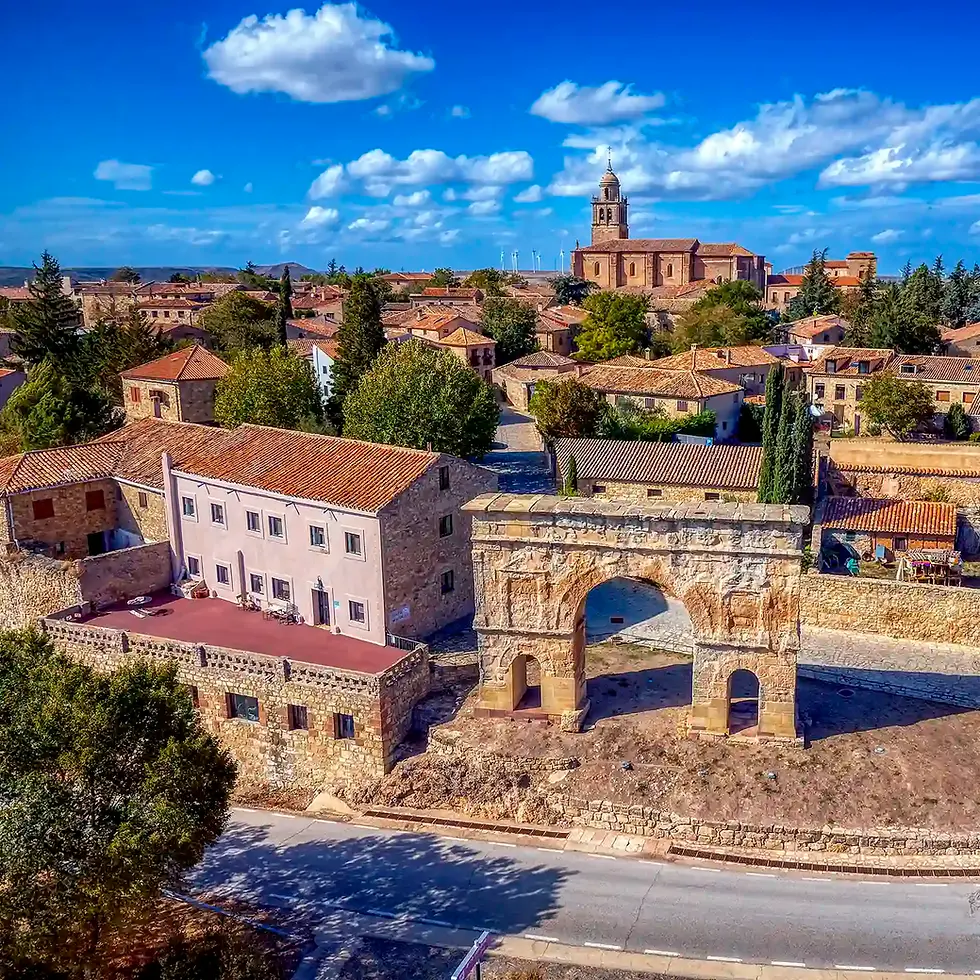
The most remarkable landmark in Medinacelli is its Roman Arch. The arch is considered the only triple Roman arch still standing on the entire Iberian Peninsula, roughly 13 metres long and 8 metres tall. It stands at the top of the village like a gate to another time, framing views of the Castilian plateau beyond.
Medinacelli itself perches on a dramatic hilltop, and the views in every direction across the Soria landscape are of a Spain that tourism has largely left alone — broad, treeless, windswept and austere.
There is barely a tourist infrastructure here, which is part of the point. The village has a slow, slightly suspended quality, as if the 21st century arrived and then thought better of it. Have a good jamón sandwich from the bar near the Plaza, find the arch, enjoy the view, and head back on the road. Some stops should be exactly this simple, and to over-programme them is to miss what makes them valuable.
Overnight Stop—Siguenza
45 minutes from Medinacelli

Siguenza operates at a different frequency to the rest of the world. The population is under five thousand. The streets are stone. The cathedral has been here since the 12th century. There is essentially no nightlife, and this is exactly the point.
The Cathedral of Siguenza is the dominant feature. A fortress-church that doubles as one of Castile's finest Romanesque buildings. Inside, seek out the tomb of Martín Vázquez de Arce, a young nobleman killed in the Granada War, known simply as El Doncel. It is one of the most affecting works of sculpture in Spain, and almost no one knows it exists.
After the stop at the cathedral, walk the medieval quarter as the afternoon light turns orange against the sandstone facades. The streets between the cathedral and the castle are almost entirely intact from the Middle Ages: narrow, slightly uneven underfoot, with carved doorways and coats of arms above lintels.
Climb to the castle walls for views across the Henares valley, where the plateau stretches away in shades of ochre and olive until it meets the horizon without any particular drama. It is a landscape of tremendous, understated severity.

Dinner should be in the Parador's restaurant if you're staying there. The kitchen takes Castilian cuisine seriously, which means roasted meats, thick soups, and local cheeses that taste of the dry landscape around them. The roast suckling lamb, slow-cooked in wood-fired ovens until the meat collapses from the bone, is the defining dish of this region. Order it with a bottle of Ribera del Duero and eat slowly. There is nowhere else to be.
The Parador de Siguenza itself deserves more than a passing mention. It was built as a castle in the 12th century, used as a royal residence, fought over during the Civil War, and converted into a hotel in 1976. The rooms are vast, the ceilings vaulted, the corridors hung with tapestries.
It manages the rare trick of feeling genuinely historic rather than theme-park medieval. Sitting in the central courtyard with a nightcap, surrounded by stone walls that have been standing for nine centuries, is one of those experiences that quietly recalibrates your sense of time.
Where to stay: The Parador de Siguenza is the obvious choice. Booking ahead is essential, particularly on weekends. For a smaller option, the Hotel El Doncel in the town centre offers comfortable rooms in a historic building at a gentler price point, with an excellent restaurant that shares its name with the cathedral's famous effigy.
Don't miss in the morning: Walk to the Ermita de Santa Librada on the outskirts of town before breakfast. The tiny Romanesque chapel in the fields sees virtually no visitors. Then back to the cathedral one more time in the morning light, before heading south toward Guadalajara and the final day's drive.
Day Three: Into the Capital's Orbit
Guadalajara
1 hour from Sigüenza

Most drivers barrel past Guadalajara on the motorway, so they miss the Palacio del Infantado. Considered one of the most unique buildings in Spain, built for Duke Íñigo Mendoza in 1480, with its exterior a remarkable example of late Gothic Isabelline architecture.
The facade is encrusted with diamond-point stone bosses and heraldic reliefs, a display of aristocratic ambition. The interior courtyard is even more impressive than the facade: two tiers of delicate arches surround a space that feels both monumental and intimate.
The palace now houses the Museo de Guadalajara, which gives you a reason to linger inside rather than photograph the courtyard and leave. The city itself is unpretentious. It sits in Madrid's shadow and has largely stopped worrying about it. Coffee on the Plaza Mayor before the final stretch south.
Alcalá de Henares
30 minutes from Guadalajara

Alcalá de Henares was the birthplace of the Spanish author Miguel de Cervantes in 1547. The Cervantes Birthplace Museum, which houses first editions, has been reconstructed in the style of a 16th-century Castilian home, and the museum is modest and well done. It earns its place on the itinerary without demanding too much of your afternoon.
The University of Alcalá, founded in 1499, gives the city its real character. The old student quarter, with its colonnaded streets and Renaissance courtyards, feels genuinely alive. The Paraninfo, the great hall of the original university building, is a masterpiece of Spanish Plateresque architecture: the stone facade, so densely carved, seems to vibrate. Each year, it hosts the presentation of the Cervantes Prize, Spanish literature's highest honour, attended by the King of Spain.
Walk the Calle Mayor from the Cervantes house to the university, and you've covered the essential mile of one of Spain's most historically loaded streets. Then, reluctantly, get back in the car.
The End—Madrid Río
45 minutes from Alcalá

Resist the urge to head straight to the city centre. Instead, enter Madrid along the Manzanares River and park near the Puente de Segovia, the oldest bridge in the city. The Madrid Río park, built over a buried motorway, is one of contemporary Europe's great civic achievements: kilometres of riverbank paths, fountains, children's playgrounds, and gardens that Madrileños have adopted with total conviction.
On a weekend afternoon, it is one of the most cheerful places in the city.
Walk north from the river up into La Latina neighbourhood, find a terrace table in the Plaza de la Paja, and order a vermut, the ritual pre-lunch aperitivo that Madrid has elevated to a near-sacred institution. Watch the neighbourhood go about its Saturday. Read more about what to see and do when in Madrid: 19 top things to do in Madrid


